


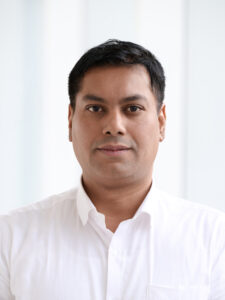
Dr. Indrajit Ghosh was born in Maheshpur, a small village in the state of West Bengal, India. He earned his Bachelor’s degree in Chemistry (Honours) from Presidency University, Kolkata (formerly Presidency College), and his Master’s degree from the Indian Institute of Technology Madras (IIT Madras).
In 2013, Dr. Ghosh received his Ph.D. with distinction from Jacobs University Bremen under the supervision of Professor Werner M. Nau. He then moved to the University of Regensburg to pursue postdoctoral research with Professor Burkhard König. In 2017, he spent a year at the Max Planck Institute of Colloids and Interfaces, working with Professor Markus Antonietti.
Dr. Ghosh began his independent career in 2025 as a research group leader at the VSB – Technical University of Ostrava, where he heads a research group at the Materials Envy Lab (MELab).
Dr. Ghosh has made foundational contributions to the development of several key concepts in photocatalysis–including ConPET, SenI-ET, chromo-selective catalysis, and AD-HoC catalysis–which have significantly expanded the scope of visible-light-driven organic synthesis. He has also played a pivotal role in advancing semiconductor photocatalysis using mpg-CN, enabling complex transformations such as the double C–H functionalization of heteroarenes.
Currently at MELab in Ostrava, Dr. Ghosh leads research on the design and development of functional materials and single-entity catalysts for photochemical transformations. His interdisciplinary work bridges organic chemistry and materials science, focusing on chemical reactions that remain challenging with conventional approaches.
Dr. Ghosh has authored over 60 peer-reviewed publications, which have been cited approximately 6,500 times, reflecting a current h-index of ≥35 (Google Scholar).
Academic Career
| 05/2025 – Present | VSB – Technical University of Ostrava Independent Research Group Leader |
| 2013 – 2016 & 2018 – 2025 | University of Regensburg Postdoctoral Research Associate with Professor Burkhard König |
| 02/2017 – 12/2017 | Max Planck Institute of Colloids and Interfaces Postdoctoral Research Associate with Professor Markus Antonietti |
| 2008 – 2013 | Jacobs University Bremen Ph.D. in Chemistry (with distinction) with Professor Werner M. Nau M.Sc. in Nanomolecular Science (Research advisor – Professor Werner M. Nau) |
| 2005 – 2007 | Indian Institute of Technology Madras M.Sc. in Chemistry (Research advisor – Professor Ashok K. Mishra) |
| 05/2006 – 07/2006 | Saha Institute of Nuclear Physics Research internship (Research advisor – Professor Samita Basu) |
| 2002 – 2005 | Presidency College, Kolkata B.Sc. in Chemistry (with Honors; Additional subjects: Mathematics & Physics) |
Awards & Fellowships
| 2009 | OFID (the OPEC fund for international development) fellowship to attend the “59th Lindau Nobel Laureate Meeting” |
| 2008 – 2010 | Fellowship of the “Nanomolecular Science graduate program”, Jacobs University Bremen |
| 2007 | Fellowship of the Council of Scientific and Industrial Research (CSIR) |
| 2007 | Graduate Aptitude Test in Engineering (GATE) |
| 2005 – 2007 | Merit Scholarship, Indian Institute of Technology Madras (awarded for all four semesters) |
Invited Talks
| 03/2026 | Department of chemistry, university of Calcutta (Kolkata, India) |
| 02/2026 | The International Conference on Sustainable Solutions Through Modern Chemistry (Shivaji University, Kolhapur, India) |
| 02/2026 | 3rd international conference on “NanoMaterials and Sustainable Applications” (Aurangabad, India) |
| 10/2025 | School on Sustainable Catalysis (Liblice Chateau, Czech Republic) |
| 10/2025 | 17th international conference on nanomaterials – research & application (NANOCON 25, Brno, Czech Republic) |
| 05/2025 | 9th annual international biennial “Nanomaterials and Nanotechnologies Meeting” (NanoOstrava 2025, Ostrava, Czech Republic) |
Five self selected publications
General cross-coupling reactions with adaptive dynamic homogeneous catalysis
I. Ghosh*, N. Shlapakov, T. A. Karl, J. Düker, M. Nikitin, J. V. Burykina, V. P. Ananikov, B. König*, Nature, 619, 87-93 (2023).
See also the research briefings in Nature “(Nickel catalyses a host of chemical reactions in a general method; https://www.nature.com/articles/d41586-023-01796-2)”.
Organic semiconductor photocatalyst can bifunctionalize arenes and heteroarenes
I. Ghosh, J. Khamrai, A. Savateev, N. Shlapakov, M. Antonietti, B. König, Science, 365, 360-366 (2019).
See also the perspective in Science (A durable semiconductor photocatalyst, Elizabeth Swift, Vol. 365, Issue 6451, pp. 320-321), highlights in C&E News (Robust photocatalyst does double duty, Vol. 97) and Chemanager (Fotokatalysator aus Harnstoff, 11.12.2019).
Sensitisation-initiated electron transfer for photoredox catalysis
I. Ghosh, R. S. Shaikh, B. König, Angew. Chem. Int. Ed., 56, 8544-8549 (2017).
VIP paper & Featured on the (back)cover page. See also the highlight in Angew. Chem. Int. Ed. (M. Brasholz, Angew. Chem. Int. Ed., 56, 10280-10281 (2017)).
Chromoselective Photocatalysis: Controlled bond activation through light-color regulation of redox potentials
I. Ghosh*, B. König*, Angew. Chem. Int. Ed., 55, 7676-7679 (2016).
Hot paper & Featured on the (back)cover page.
Reduction of aryl halides by consecutive visible light-induced electron transfer processes
I. Ghosh, T. Ghosh, J. I. Bardagi, B. König, Science, 346, 725-728 (2014).
Featured in C&E News (November 10, 2014), Synfacts (2015, 11(4), 0436), Mittelbayerische (Regional newspaper of Regensburg, Germany; November 14, 2014).