


A team of scientists, including researchers from VSB – Technical University of Ostrava, has developed a new graphene ink for producing inexpensive and sensitive printed sensors. Researchers from the Materials-Envi Lab (MEL) at CEET and the IT4Innovations, together with colleagues from CATRIN at Palacký University and Charles University, applied single-atom engineering to the development of the ink for the first time. By incorporating individual copper atoms into the material, they achieved highly sensitive detection of dopamine – a neurotransmitter involved in transmitting signals between nerve cells. The approach, presented in the journal Advanced Science, holds strong potential for applications in medical diagnostics. The research was also supported by the REFRESH project.
The published results introduce a new class of sensing materials with considerable potential for medical diagnostics. The researchers present a broadly applicable platform for developing graphene inks containing individual metal atoms and open the way towards scalable, reproducible and material-efficient production of advanced electrochemical sensors. “We are only at the beginning and are fascinated by the new possibilities opening up before us. We can see that by changing the type of atom, we can control the sensitivity and selectivity of the sensor. In addition to dopamine, we can also determine immunoglobulins very precisely – antibodies whose levels and types may serve as important indicators of autoimmune or infectious diseases,” said Radek Zbořil, one of the paper’s authors and Head of the Materials-Envi Lab (MEL), who also holds a position at CATRIN, Palacký University Olomouc.
Single-atom engineering makes it possible to control the chemical reactivity of materials at the level of individual atoms. Its broader application in medical diagnostics has so far been limited by a lack of atomically engineered materials and printable inks based on them. Researchers have now developed a new class of single-atom-doped graphene materials as well as an ink for producing sensitive printed sensors. Copper proved particularly effective for dopamine detection, which is important for biomedical research and the development of advanced diagnostic technologies for diseases including Alzheimer’s disease.
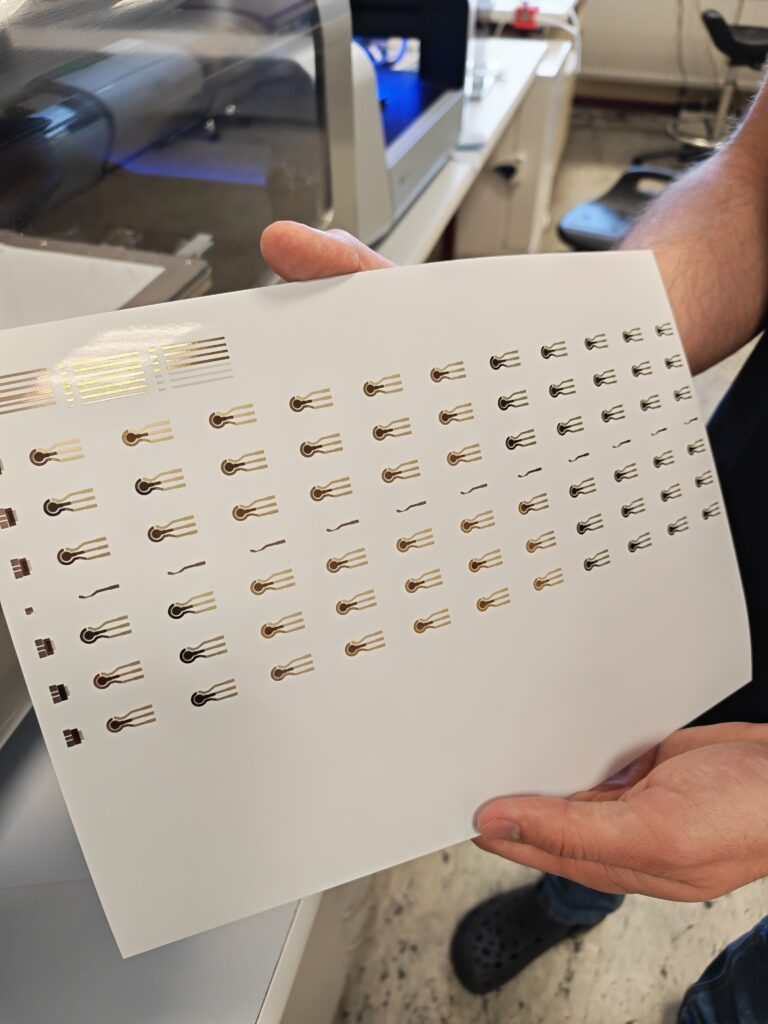
“The NGA-Cu ink we developed enables the production of fully inkjet-printed, sustainable paper-based electrodes at very low cost. Each sensor requires only 1.3 micrograms of active ink, costs approximately one Czech koruna and provided a stable response for at least three months. The ink is also fully compatible with commonly available materials inkjet printers. This creates significant potential for producing affordable, digitally designed sensors whose function can be tailored atom by atom,” said the corresponding author of the paper Michal Otyepka from IT4Innovations and CATRIN.
The basis for this new generation of single-atom inks was nitrogen-doped graphene acid (NGA), which CATRIN researchers developed several years ago. They have now progressively enriched it with different individual metal atoms, including copper, iron and manganese.
“We found that the electrochemical response depends fundamentally on the type of atom used. While copper atoms significantly enhance the dopamine signal, other metals suppress it. What matters, therefore, is not only the presence of isolated metal atoms but also the specific metal involved. This is a very important finding for the further development of biosensors,” explained first author Martin-Alex Nalepa.
Electrochemical biosensors can find applications not only in medicine but also in food quality control, drinking-water monitoring and environmental pollution monitoring. Their key components are functionalised electrodes, and graphene-based materials have proved particularly suitable for their production.